2025
-
Aug 2025
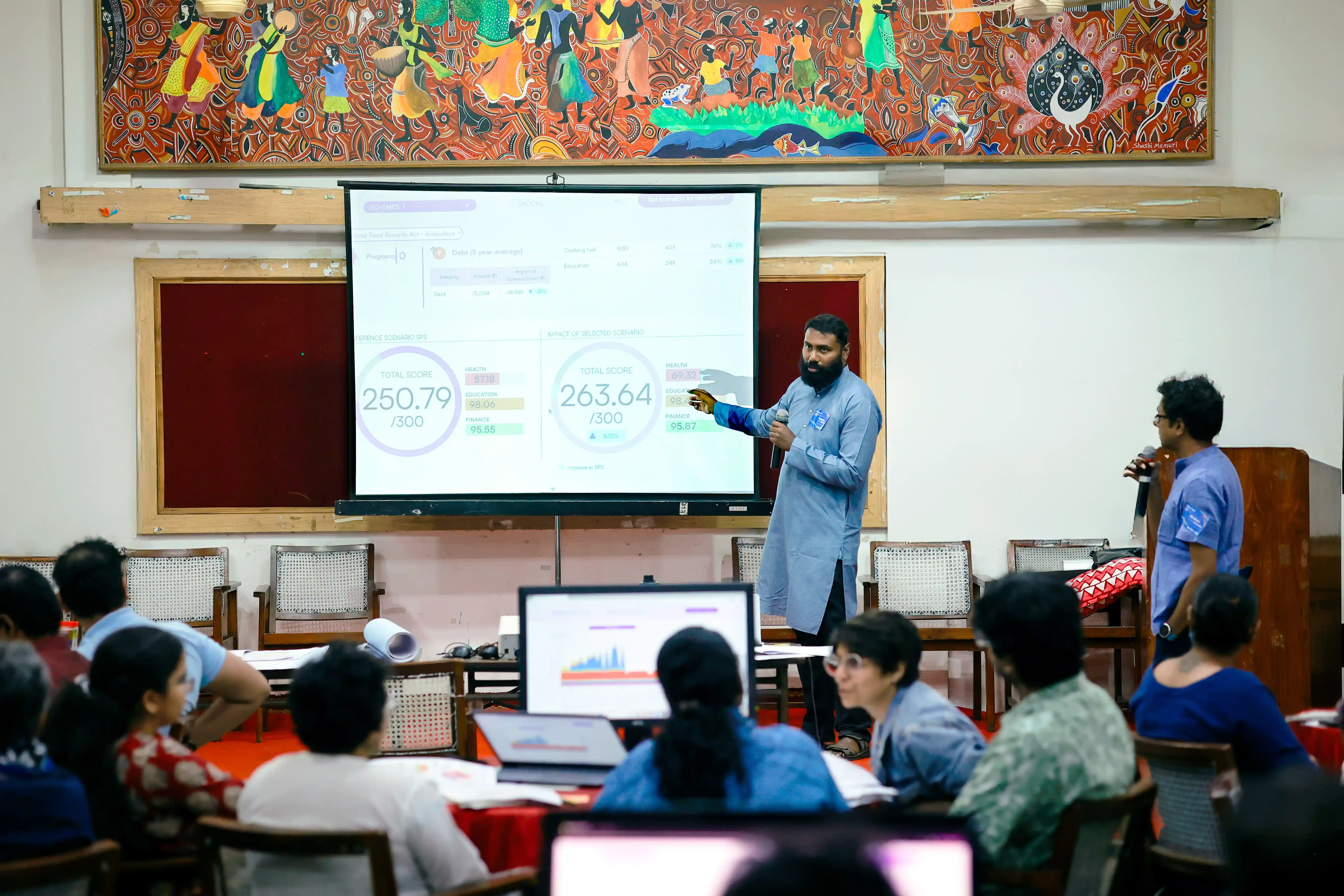
Reimagining Resilience -
Workshop ReportA participatory workshop exploring social protection measures.
read publication
-
Jan 2025
Climate Vulnerability Assessment Using Household Simulation - E-QLT
Simulating pathways towards household resilience (The 22nd edition of India Conference at Harvard Policy Hackathon 2025)
read publication
2022
-
Jun 2022
Participation in Play
Demonstrating a practical approach to people's participation in the context of policymaking during COVID-19
read publication
-
Feb 2022
Networks of Care: Partnerships for Relief and Support during the COVID-19 Second Wave in Karnataka
Harsha K, Srinidhi Santosh, Ursula Uday, Vaibhav Dutt
read publication
2021
-
Jun 2021
Enabling Public Participation in Shaping the Inclusive Energy Transition Through Serious Gaming---Case Studies in India
Bharath M. Palavalli, Sruthi Krishnan and Yashwin Iddya
read publication
-
May 2021
COVID-19: Sustaining Momentum and Collaborations, Case study on the Relief Ecosystem in Karnataka
Kiran Rajashekariah (GIZ – SUDSC), Krishna Kumar (GIZ – SUDSC), Bharath M. Palavalli (Fields of View), Sruthi Krishnan (Fields of View), Harsha K (Fields of View), Ketaki Paranjape (Fields of View), Vaibhav Dutt (Fields of View), Srinidhi Santosh (Fields of View), Yashwin Iddya (Fields of View)
read publication
2019
-
Oct 2019
We Are Not Users - Dialogues, Diversity, and Design
Eswaran Subrahmanian, Yoram Reich and Sruthi Krishnan
read publication
-
Oct 2019
Social Inclusion through Play, A New Methodology for Public Transport Planning in the Indian Context
Bharath M. Palavalli, Harsha Krishna, Srijan Sil and Anirudh Thimmaiah
read publication
-
Sep 2019
Developing Resilience Scenarios and Strategies through Participatory Simulations – Case of Metropolitan Chennai - Case Study 3
Poornima Dore, Sruthi Parija and Simrat Swani
read publication
2018
-
Sep 2018
Laundry Day: an illustrated children's book
Mathangi Subramanian and Shambhavi Singh
read publication
-
Mar 2018
Inclusive Wealth Report 2018: Measuring Progress Towards Sustainability
Bharath M. Palavalli, Srijan Sil and Anantha Kumar Duraiappah
read publication
-
Feb 2018
Budget 2018 and Interactive Media: How to Design Nuanced Games on Complex Topics
Bharath M. Palavalli and Sruthi Krishnan
read publication
2014
-
Oct 2014
Analyzing gaming-simulations using video based techniques.
Bharath M. Palavalli, Harsha Krishna and Dinesh Jayagopi
read publication
-
Oct 2014
Modelling technology, policy and behaviour to manage electricity consumption.
Harsha Krishna, Onkar Hoysala, Murali Krishna G., Bharath M. Palavalli and Eswaran Subrahmanian
read publication
-
Oct 2014
An Interdisciplinary, Dialogic Approach to Develop an Electronic Device to Enhance Freedom and Mobility of Women in Public Spaces in the Indian Context - Illustrated by the Case of Convers[t]ation.
Yashvanth M. Kondi, Daksh V., Sruthi Krishnan, Madhav Rao
read publication
2013
-
Jun 2013
Designing Energy Policy through the Indian Energy Game.
Onkar Hoysala, Aditi Murthy, Bharath M. Palavalli, Eswaran Subrahmanian and Sebastiaan Meijer
read publication
-
Apr 2013
Context, collaboration and complexity in designing - The pivotal role of cognitive artifacts.
Subrahmanian Eswaran, Reich Yoram, Sruthi Krishnan
read publication
2025
2023
2022
Our goal is to design better policy using games and simulations. Our work involves three
inter-related
threads:
PolicyLab where we undertake research at the intersection of art, social
sciences, and technology to design games and simulations;
School of Policy where we
train policymakers and civil society groups in the use of these tools;
Policy in Play
where we design artefacts such as graphic novels and games to make policy more accessible.
Some of our current projects include: Building a game for the UN for students of economics and sustainability studies to understand the Inclusive Wealth Indicator (IWI), an indicator proposed as a complement to the GDP and HDI; ₹ubbish! a game on waste management in Bangalore; SimCity - building simulations to understand and plan for cities in the Indian context; and building a game for the Institute of Plasma Research, a Government of India undertaking.
Games for policy
Be it ‘Go’ with its deceptively simple rules governing smooth ovals across a chequered board or hopscotch that enlivens school yards and streets, games are integral to any community’s cultural heritage. Game play involves and invokes memories of fun, friendship, and sometimes failure too.
It is but natural that the immersive power of games has been harnessed to address real-life issues. A lot of research has gone into understanding how games can be used in different situations and their potential is mostly untapped. Not only do games provide an inexpensive way of mimicking real-life situations, but they also allow us to learn and experience in a safe space, and the learning stays with us.
In the area of policymaking, games can be used in the following ways:
Games for preference elicitation
For policymaking that is responsive to the needs of people, it is critical to include the needs and preferences of the people to design the policy. Games are a powerful medium to collect this intangible, unquantifiable data. Games can model complex systems without losing nuance. As the players interact with the system in the game and decide on their choices, these choices are the data required to understand the players’ preferences and biases. At Fields of View, the preferences elicited through games are fed into our simulations to generate different options for policymakers to choose from.
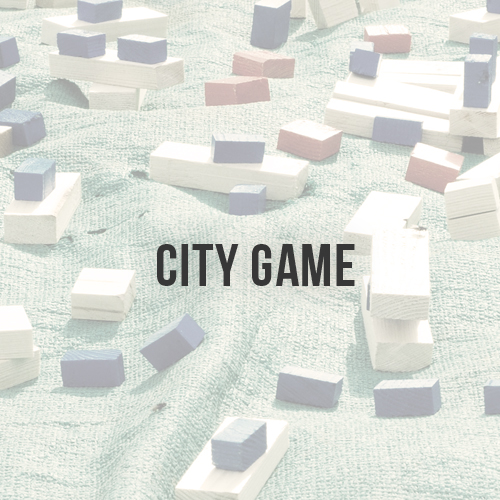
Example: City game, Namma Khate Namma Kathe, Joint Road Forward etc.
Games for policy testing
In pluralistic societies, there are different policy scenarios that policymakers can potentially opt for. Once policymakers short-list certain choices, they can be tested through games with the target audience. The outcomes of such policy-testing game sessions provide insights for the policymakers to make the most appropriate policy choice.
Examples: Map my city, City game, PIEMAC, Electricity market game etc.
Games for capacity building
As games can model complex systems without losing nuance, games can be used by policymakers and civil society to learn about the policymaking process, and the challenges in different domains of policy-making.
Example: Indian energy game, Rubbish!, Cantor’s world.
Games to make policy accessible
As we can leverage the visual space in games, they provide a powerful tool to communicate with audiences with different literacy-levels and languages.
Example: Rubbish!
Simulations for policy
At Fields of View, we design bottom-up, exploratory simulations to make better policy. Models are representations of the real world. A simulation can be understood as a model in action over time. With advanced computing power at our disposal, simulations nowadays can crunch large quantities of different kinds of data, and therefore are a powerful tool to aid policymakers in decision-making.
Traditionally, simulations model either the micro-level or the macro-level. For instance, transportation simulations usually model either bus stops, roads, etc (micro-level) or at the scale of national highways (macro-level). What is required are simulations that operate in between these two levels, at the meso-level. Such meso-level simulations meld both macro and micro-level data. At FoV, we build meso-level simulations.
Moreover, the simulations at FoV are bottom-up, unlike traditional simulations. We model individual actors and their preferences. We elicit these preferences using our games. These preferences are intangible, unquantifiable data, which other simulations do not handle. Thus, in our simulations these individual actors or agents interact with each other and different scenarios emerge. Using these bottom-up simulations, which combine both tangible and intangible data, we generate multiple scenarios, which the policymakers can explore and choose from.
At Fields of View, we design exploratory, bottom-up simulations in the areas of transportation, energy, and urban poverty.
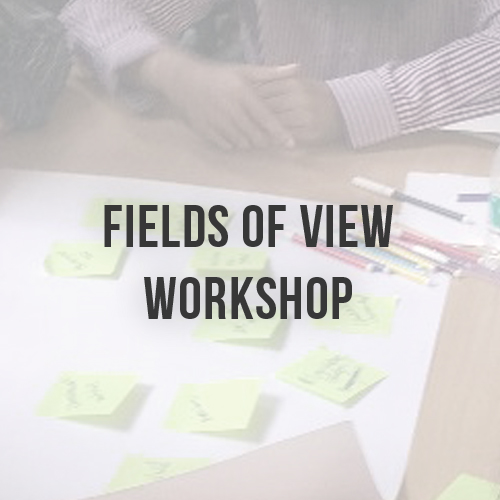
Based on our in-house interdisciplinary design research methodology, we offer different workshops and courses. The 'Fields of View' workshop is our most popular workshop to help define the problem and design in contexts where there are different perspectives/disciplines involved. 'Unpack Play' is our game design course. To know more, click on the images.
Bringing together diverse disciplines, we have developed products in-house to address social and technical challenges. Convers[t]ation is an ATM-like kiosk that can be installed in public spaces such as bus stops where women can come and report cases of sexual harassment. Phoenix is a platform for agent-based modelling. To know more, click on the images.